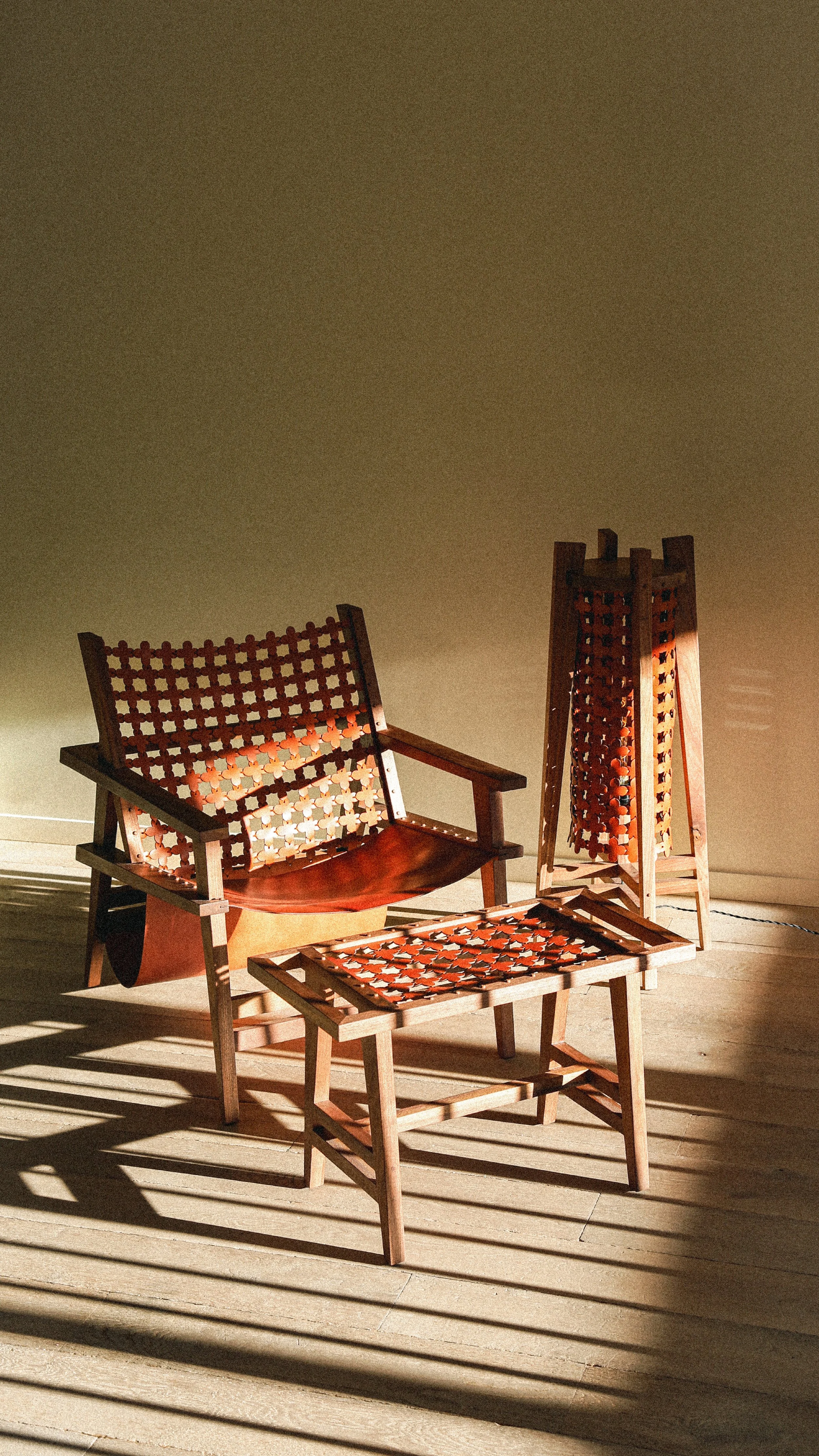
IN CONVERSATION WITH EMMA BATSHEVA
IN CONVERSATION WITH EMMA BATSHEVA
About Emma Batsheva
Emma Batsheva is an artist-designer and passionate Artistic Director based in Paris, whose work centers on minimizing waste and maximizing potential across objects, spaces, and concepts. A Cum Laude graduate of Design Academy Eindhoven, she blends contemporary techniques with craftsmanship, focusing on durability, sustainable transitions, and closed-loop material cycles. Currently, she serves as a Freelance Visual Merchandising Designer for Louis Vuitton. As the founder of her own studio, she has quickly gained notable recognition, including being a Finalist for the Green Concept Awards and the Louis Vuitton Design Graduates Initiative. She is available for hire in fields such as Product Design, Artistic Direction, Zero Waste Systems, and Set Design.
1. How did you break into the furniture or design field?
I was trained in fashion and art direction, but I’ve always been drawn to objects that age, that carry memory. When I began experimenting with structure and material, furniture became my natural language, large enough to hold emotion, tangible enough to invite touch.
2. Describe your practice in more detail. What inspired you to create your current concept or studio branding?
Emma Batsheva Studio stands between collectible design and ethical production. My visual identity was born from contrasts: the sacred and the raw, the poetic and the practical. I wanted the name itself to feel like a signature, not a label, so Batsheva is my second surname, it does not even show on my passport, but this is deeply rooted in my identity and I wanted to honor it by making it more visible.
3. Who would be your icons and muses?
Isamu Noguchi for his sculptural sensitivity and Rei Kawakubo for her fearless deformation of beauty and her magazine ‘SIX’. Beyond design, I’m inspired by noses (perfume makers), the way they shape invisible emotion. My muses are the people who manage to turn discipline into poetry.
4. Tell me more about designers or artists you would love to collaborate with.
I’m most inspired by artists who bend materials to their own language, people like Taras Yoom, who treats form with a kind of benevolent surrealism, or Anthony Authié, whose worlds feel both futuristic and deeply tactile. I’d also love to collaborate with designers like Loan Favan from Naula Studios, whose sensitivity to identity and materiality resonates with my own approach. Beyond them, I’m drawn to craftsmen and makers with strong savoir-faire, glassblowers, leather specialists, or textile artisans who understand material from the inside out.
5. When designing a furniture piece, what is the most important factor for you?
Proportion and sourcing of materials. A piece must feel balanced before it looks beautiful. I’m obsessed with the point where a structural decision suddenly turns into a feeling, where a curve makes you breathe differently, and how beauty can drive you towards an objects before knowing its own story.
6. How does your multi-hatted identity (Artist / Designer / Director) ensure the durability and longevity of your work in today’s rapid design cycle?
These three roles allow me to protect my work from different angles. The artist defines the intention and emotional depth. The designer translates that into form, proportion, technique. And the director ensures the piece can actually live in the world, structurally, financially, and strategically. Switching lenses keeps my work anchored even in fast-paced cycles. Longevity comes from alignment: when the narrative, the object, and the production model all move in the same direction, the piece isn’t just relevant now, it remains coherent years from now.
7. What systemic change have you achieved by merging contemporary techniques with artisan craftsmanship to minimize waste?
Laser-cutting was my turning point. It allows precision with minimal off-cut and transforms leftovers into modules rather than trash. It also reconnects craft to industry, showing that technology doesn’t erase artisanship; it can amplify it when used consciously.
8. How does your obsession for perfumery translate into designing tangible objects that offer a crucial sensory experience in a digital world?
Perfume taught me how to sculpt the invisible. When I design, I think in layers and motion, top notes, heart, and base. A chair can have a base note, a vase can breathe. Material scent, temperature, and texture become a form of silent communication. I want objects to feel like memories you can touch.
9. If you could give one piece of advice to a young designer torn between the speed of digital
production and the slow mastery of traditional craft, what would it be?
Learn the rhythm before you break it. Master one gesture with your hands, then translate it digitally. Technology is a tool; craft is a language. You need both to tell stories that last.
10. Your path spans Louis Vuitton, independent studios, and your own label. What is the one lesson these radically different environments taught you about authorship and owning your design voice?
Working across these different worlds taught me that authorship is not about volume, it’s about clarity. At Louis Vuitton, I learned how to design within very precise brand codes and industrial constraints without losing nuance. With independent studios, I saw how agility and experimentation can stretch an idea in unexpected directions. With my own label, there is no filter, which is both terrifying and liberating. The common lesson is that your voice has to be strong enough to adapt to different contexts, but precise enough not to dissolve in them.
11. You’ve been recognized by major programs from the Green Concept Awards to the Material District Young Talent Program. Which moment of recognition shifted your confidence or direction the most, and why?
The moment that truly shifted my confidence was the Louis Vuitton Design Graduate Initiative. We had two months to develop a project, I had to do mine in five days (and nights), convinced I’d never be selected. Yet I kept passing each round until I found myself among the finalists at Maison d’Asnières, the youngest by almost ten years. The feedback I received there was powerful: they showed me who I was becoming, and also why I wasn’t ready yet. One year later, after countless applications and interviews, I finally joined Louis Vuitton, and I knew exactly why I belonged. That experience didn’t just give me recognition; it gave me clarity and direction.
12. From artistic direction to jewelry design to regenerative furniture, your practice moves across disciplines. What is the common thread you now realize was guiding all these experiences from the beginning?
For me, the link has always been creative challenge, pushing myself into territories I knew nothing about and learning everything directly through making. Every shift in discipline came from a desire to stretch my limits, reinvent my tools, and prove to myself that I could shape a new language each time. That curiosity, that need to dive into the unknown, has always guided me more than any specific medium.