IN CONVERSATION WITH GERLACH &HEILLIG
IN CONVERSATION WITH GERLACH &HEILLIG
About Gerlach & Heillig
Amsterdam-based design duo, founded by Kyra and Lenn Heilig, whose practice navigates the intersection of industrial design, collectible furniture, and material research. Influenced by their studies at the State Academy of Fine Arts in Stuttgart and professional stints at studios like Forma Fantasma, the duo treats objects as "artefacts" that carry deep geological and cultural narratives. Their process is defined by an interdisciplinary, research-heavy approach often collaborating with geologists, archivists, and craftspeople to uncover the "internal logic" of materials like silver fir or oil shale. Rather than creating for purely aesthetic reasons, they use their studio as a platform to challenge market conventions and ask critical questions about extraction, regional heritage, and the evolving role of objects in a saturated world.
How did you break into the furniture industry or design field? Describe your practice in more detail?
Gerlach & Heillig
We both entered the furniture and design field through a combination of our academic education and hands-on studio experience. We studied together at the State Academy of Fine Arts in Stuttgart which is a place where design education is deeply conceptually-driven and experimental. It was there that we started working as a duo, realising that we shared the same conceptual ethos and a curiosity for origins, materials and cultural references. During and after our studies, we both worked in studios that strongly shaped how we understand the design discipline today including Formafantasma, Studio Hanne Willmann and Studio Germans Ermics. These experiences and our academic education allowed us to work and think within a broad spectrum of design: from classical industrial design processes to questioning conventions and reframe the role of objects in the nowadays world. Our practice today moves between collectible design and industrial design, and our objects sit somewhere between furniture and artefact. Every project begins with research into the historical, geological, or cultural layers of a material. We are interested to understand a material’s origin, its local context, and the production systems it once shaped do we begin to design. This approach allows us to rethink familiar materials, reconnect objects to their regional narratives, and challenge what contemporary furniture can be beyond aesthetics or functionality.
Describe your practice in more detail. What inspired your current concept or studio branding?
Gerlach & Heillig
Our practice sits between furniture, artefact, and research. We follow materials back to their origins for instance from geological, cultural, and industrial nature; and allow these layers to construct the internal logic of each piece. We let context, production methods and narratives guide the direction of the work. Our studio identity grew from the same mindset. The “&” in Gerlach & Heillig is not only a symbol but represents a dialogue and an open invitation to collaboration. No research project emerges in isolation. Our process is built on constant exchange with other professionals from different fields from designers, to craftspeople, geologists, archivists, or museums. The name is also a quiet homage to our grandfathers, who both worked with wood: Lenn’s as a carpenter, Kyra’s as a wood sculptor. This generational link reinforces our interest in narrative and collaboration: understanding where things come from, who shaped them, and how these stories continue through contemporary objects.
Who would be your icons and muses? (+Tell me about designers or artists you’d love to collaborate with.)
Gerlach & Heillig
We find it interesting if practitioners are treating materials in an unconventional way. At the moment we are for instance very fascinated by Anne Holtrops works and his unconventional approaches in architecture just to name an example. Architecture is usually a relatively rigid field with lots of rules and regulations. Its refreshing to see designers or architects who break with the conventions. But we also draw inspiration from other fields like philosophy or art. When it comes to a potential collaboration we are always striving to work interdisciplinary. Designers can learn a lot from different creative fields like architecture, art, scenography, and vice versa.
When designing a furniture piece, what is the most important factor for you?
Gerlach & Heillig
The furniture world has already seen countless shapes and designs. Its not our intention to creating something purely for aesthetic reasons. For us, a new furniture object is emerging from a process of dialogues between the two of us, the collaborators, and with the material itself. Often, this process includes questioning the existing market rather than reinforcing it. Also in order to create something new. As designers, we are constantly challenged to observe the shifts of our time. The challenges we face today are not the same as those of 30 or 40 years ago. During our academic studies, we repeatedly asked ourselves whether the term industrial design still applies to our practice although that was the name of the department we studied at. Our goal is not simply to serve an industry, but to ask the right and necessary questions to the industry. The conceptional approach is luckily something that is very refreshing for clients to see. Manufacturers and major furniture brands are often navigating their own transitions, and design has a role in challenging, supporting, and reshaping that evolution. Ideally a new furniture piece would contribute something meaningful, not just add another object to an already saturated field.
How does your investigation into the cultural and historical layers of a material ultimately change or define the object you create?
Gerlach & Heillig
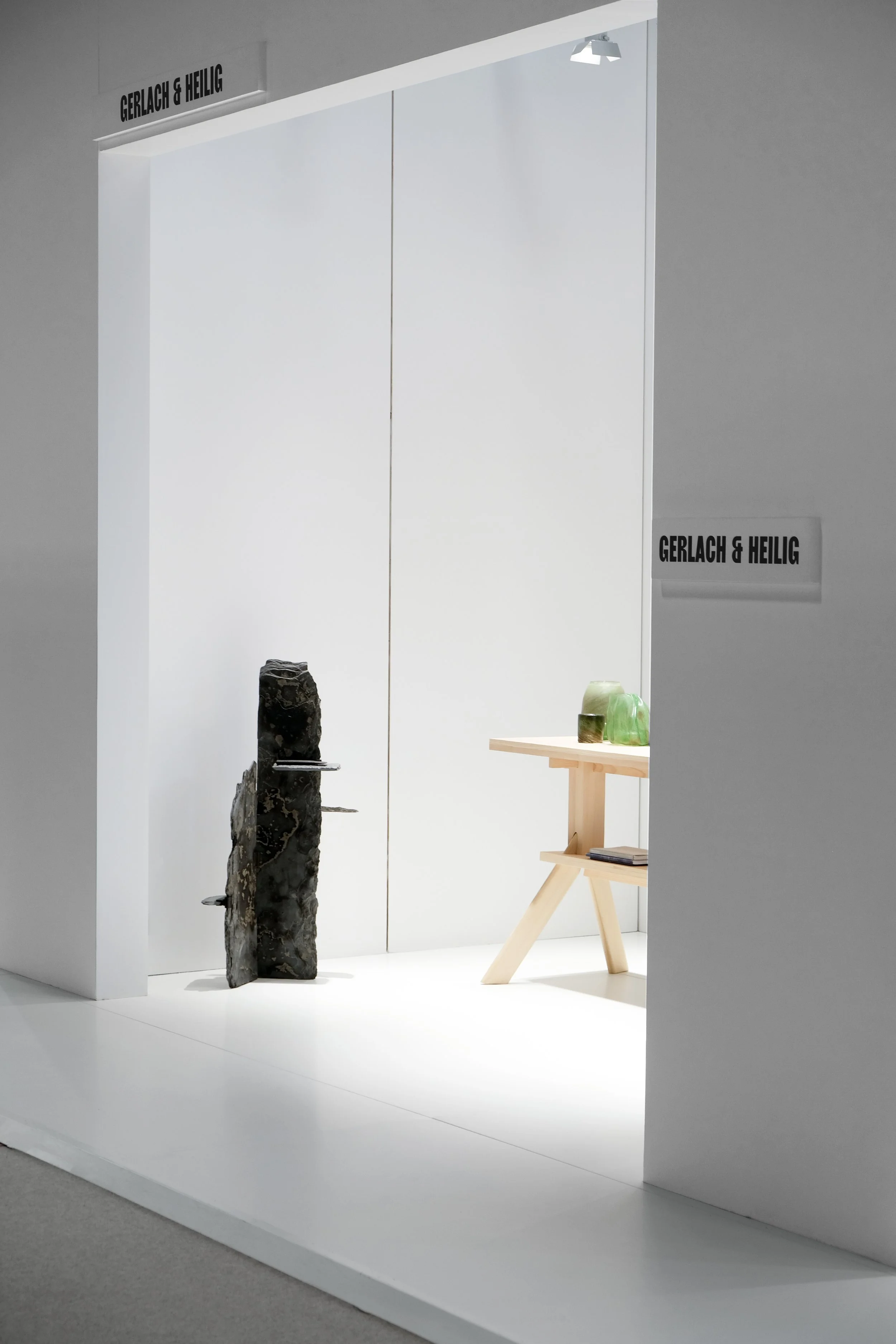
The narrative of our cultural or historical investigations are visible in the objects themselves. Two projects that illustrate this approach are Traditional Heritage and Hammered Scapes. Traditional Heritage explores historic craft techniques from a specific region and reinterprets them in a contemporary context. It is a research project dedicated to the German Black Forest. We developed a furniture series that reimagines classical wedging techniques, using silver fir - a wood with a long regional history and the resilience to withstand future climatic conditions. The mouth- blown glass vessels in the project contain grains of Black Forest Buntsandstein, visible as rough, colorful speckles that carry geological time within them. The geological origin of the material. becomes visible in the outcome of the vessels. The Hammered Scapes series, on the other hand, is an ongoing exploration of surface, texture, and materiality but also a reinterpretation of a very old craft. Each object is the result of intensive research and hands-on experimentation, allowing material behaviour to guide formal decisions. Together, these works have something in common. The narrative, context, and process are not additions to the design but a fundamental aspect of their existence.
You emphasize an open-ended dialogue with diverse professionals. What is one piece of unexpected insight gained from a non-designer that significantly impacted a project?
Gerlach & Heillig
For our project Fragments of Mining, we spent several months in conversation with a geologist. She took us into a quarry in the Swabian Jura in southern Germany, where oil shale is extracted for both petroleum production and the concrete industry. Walking through the exposed sediment layers with her completely shifted our perspective: each stratum contained fossils of dinosaurs and Jurassic marine life - a place that was simultaneously an industrial site and a natural archive. The geologist pointed out a simple but profound contradiction: the same fossils we admire behind glass in museums are, in this quarry, crushed by the ton every day to extract resources. This tension-between fascination and exploitation, between preservation and consumption - became the conceptual core of the project. Her insights forced us to ask ourselves uncomfortable but necessary questions: With what intention do we, as designers, enter a quarry? What are the values we bring into such a landscape? And what does it mean to extract meaning from a material that is itself under constant extraction? The result was a fragmentary installation positioned between furniture and sculpture. Each piece reveals a different story or physical property of the stone. One object stands on legs formed from a naturally split rock, honouring the stone’s tendency to cleave cleanly. Another uses metal clamps marked with geological dates, quietly revealing the timescale of its formation. Together, these works explore the origin of the material while asking a broader question of value -what do we choose to preserve, and what do we accept to destroy?
How has the transition from the Black Forest to Amsterdam influenced the narratives or materials you choose to focus on in your design work?
Gerlach & Heillig
Living in the Black Forest taught us to work closely with raw materials and local crafts. Amsterdam shifted our perspective. The city is open, culturally rich, and fast in its exchange - yet space and resources are limited. This pushes us to rethink our process, use more digital tools, and explore new methods. Each place shapes our work differently: the forest gave us material depth, while Amsterdam encourages experimentation and new forms of collaboration.
If you could give one piece of advice to a young designer torn between the speed, of digital production and the slow mastery of traditional craft, what would it be?
Gerlach & Heillig
Don’t position the two worlds against each other. A hands-on approach and a traditional craft teaches how to judge, refine, and understand materials therefore we would always recommend to explore the physical materials first. Digital tools can later expand the imagination like an extra arm but an in-depth understanding of a matter comes by physical experiences. What matters is not the tool - it’s more the questions you’re raising.